
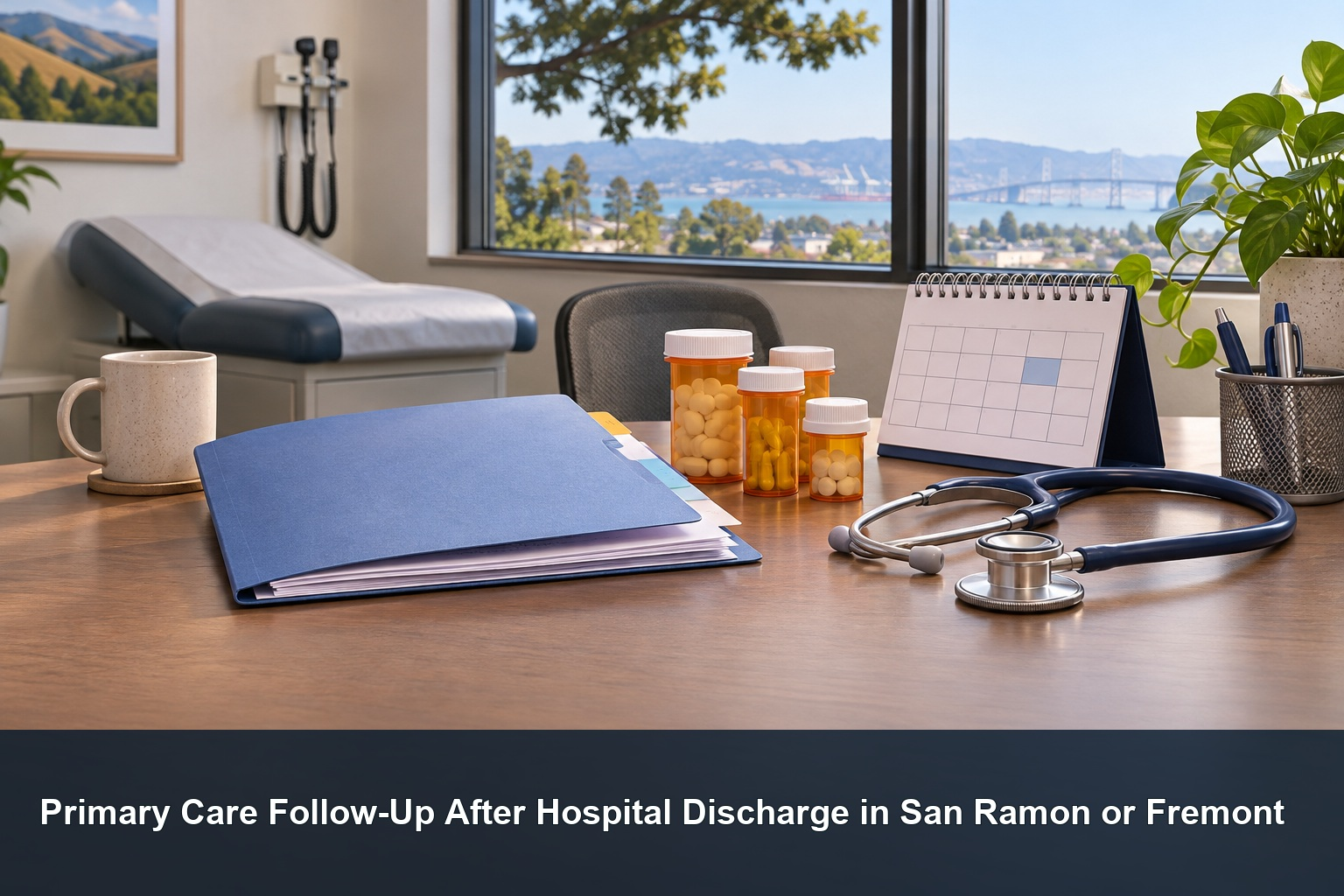
Leaving the hospital is a transition, not the end of care. New medicines, pending tests, specialist visits, and recovery instructions can be difficult to coordinate at home. A primary care follow-up can help connect the hospital plan to the patient’s usual health needs. Symphony Health offers primary care in San Ramon and Fremont. The timing and type of visit should follow the hospital’s discharge instructions and the patient’s condition. This guide explains what to organize before the appointment and which questions make the visit useful.

Read the discharge plan before going home
Ask the hospital team to explain the main diagnosis, what treatment was completed, what still needs attention, and whom to call for a problem. The written discharge instructions should include medicines, follow-up appointments, activity guidance, and warning signs. If a term is unclear, ask for a plain-language explanation while the team is available. Have the patient or caregiver repeat the plan in their own words to catch misunderstandings. AHRQ’s discharge guidance emphasizes the value of clear instructions and contact information. Keep the paperwork in one place rather than relying on memory after a stressful stay.
Schedule the follow-up at the right interval
The hospital may specify when the primary care clinician should see the patient. Some conditions require prompt review; others allow more time. Tell the office the hospital name, discharge date, diagnosis, and any time window stated in the instructions. Do not assume a routine annual visit is the same as a post-hospital appointment. If the office cannot meet the recommended interval, ask the hospital or care team what alternative is appropriate. Some patients also need a separate specialist appointment, home service, or test. A primary care visit helps coordinate these pieces but should not replace an urgent evaluation when warning signs occur.
Reconcile the medicine lists
Hospital discharge frequently changes doses, stops old medicines, or adds new ones. Bring the discharge medication list, the pre-hospital list, prescription bottles, over-the-counter products, and supplements. Ask the clinician or pharmacist to clarify what should be taken now. Do not restart a discontinued medicine or double a dose because it was on an older list. Note any side effects, cost problems, or pharmacy delays. AHRQ identifies medication reconciliation as a core part of safe transitions. The goal is one accurate working list that the patient, caregiver, primary care team, and relevant specialists understand.
Bring the discharge summary and test results
The primary care office may not automatically receive a complete hospital record before the visit. Ask for a discharge summary and bring any paper or electronic documents available. Note scans, lab results, and cultures that were pending when the patient left. A result that arrives after discharge still needs an owner who will review it and contact the patient. Ask whether the primary care team has the record and whether a release is needed. Bringing the information prevents the visit from becoming a guessing exercise. The clinician can then focus on what changed, what still needs monitoring, and which decisions remain open.
Review symptoms against the expected recovery
Write a short timeline of symptoms since coming home: breathing, pain, fever, appetite, sleep, mobility, swelling, mood, or anything relevant to the hospital condition. Compare them with the warning signs in the discharge plan. A symptom may be expected, but a new or worsening one may require action. Do not save an emergency symptom for a scheduled visit; use the hospital’s instructions or emergency services. For less urgent concerns, notes help the clinician see a pattern rather than a single moment. Include whether the patient can perform usual activities and whether caregiving help is available at home.
Check follow-up tests and specialist visits
A discharge plan can contain several future tasks: repeat blood work, imaging, wound check, therapy, or consultation. For each, ask who orders it, where it will happen, when it is due, and who communicates the result. A general statement such as “follow up with cardiology” is not enough if no appointment exists. Primary care can help coordinate, but the patient should keep a written list and confirm that referrals have been received. If an appointment is unavailable or a test is delayed, tell the care team rather than letting the task disappear. A clear owner for each item is one of the most useful outcomes of the visit.
Make the home plan realistic
Recovery depends on more than prescriptions. Consider transportation, food, mobility, home equipment, wound supplies, work demands, and support from family or friends. Tell the clinician if the patient cannot afford a medicine, reach an appointment, or follow an activity instruction safely. Ask whether a home health service or community resource was ordered and how to confirm it starts. A plan that looks complete on paper can fail when the patient returns to a different daily reality. The primary care team can address some barriers directly and help identify who else should be involved. Do not wait until a missed visit to explain the obstacle.
Prepare questions in priority order
The appointment may have limited time, so put the most important questions first. Examples include: Which medicine list is correct? Which symptoms are expected? What test result is still pending? When may normal activity resume? Who should be called after hours? Bring one caregiver or support person if the patient wants help remembering details. Ask for a written summary of changes and the next follow-up date. If several clinicians give conflicting instructions, name the conflict explicitly. The goal is one coherent plan, not a stack of disconnected advice.
Know when to seek immediate help
Discharge papers should list warning signs specific to the hospital condition. Chest pain, severe breathing trouble, stroke-like symptoms, severe confusion, or other emergencies require immediate care rather than waiting for primary care. Some symptoms are less dramatic but still need a same-day call. If in doubt, use the contact number on the discharge plan and describe the symptom clearly. The office can advise whether an appointment, urgent evaluation, or emergency service is appropriate. This article cannot identify the right response for an individual’s symptoms; the patient’s condition and instructions control.
A practical San Ramon or Fremont follow-up
Contact Symphony Health or the patient’s primary care office as the hospital instructs. State the discharge date and requested follow-up interval, then send or bring the hospital records and current medicine list. At the visit, confirm the diagnosis, medication changes, pending results, specialist appointments, home needs, and warning signs. Leave with a short action list that names the responsible person and date for each step. Keep it with the discharge paperwork and update it as tests and visits occur. Good follow-up is a series of completed handoffs, not simply a calendar entry.
Include the caregiver without losing the patient’s voice
A family member can help organize medicines and appointments, but the patient’s own goals and concerns should lead the conversation when the patient can participate. Ask whom the patient wants involved and what information may be shared. A caregiver can report observed changes in mobility, sleep, food intake, or confusion that the patient may not notice. The clinician can then separate those observations from the patient’s experience and the hospital record. If the patient needs an interpreter, arrange one through the care team rather than depending on a relative for complex medical decisions. A discharge plan is more likely to work when everyone knows who will carry out each step and the patient understands why it matters. Before leaving, confirm which phone number to use if a home service fails to start, whether the patient has enough medication until the next visit, and who will explain any test result that is still pending. Those small details can prevent a difficult weekend at home.
Start with the decision this topic answers
The immediate decision is how to turn the hospital’s discharge instructions into a safe home plan with named follow-up responsibilities. The primary care visit should address the transition as a whole. A sound plan begins with a specific decision. State the problem in ordinary language, describe what has already happened, and identify the result you hope for. That gives the professional or service team a chance to distinguish a routine request from one that needs a different path. Keep expectations proportional to the information available: a web page can explain options, but the details of each situation still matter. The most efficient first conversation focuses on the next verifiable step rather than a promised outcome.
Bring the evidence that changes the answer
Bring the discharge summary, current and former medicine lists, prescription bottles, pending-test list, specialist referrals, and symptom notes. If home services were ordered, bring their contact details and start dates. Good decisions rely on records that can be checked. Dates, symptoms, measurements, prior work, service agreements, financial records, or system reports can change the recommendation. Collect what is relevant and keep a simple timeline, including what changed and when. If an important fact is unknown, say so instead of guessing. A professional can then decide what to inspect, request, or test. This avoids a common problem: spending money on a solution chosen from a label alone before confirming the underlying cause.
Compare options on the same basis
Compare the hospital plan with the patient’s pre-hospital routine. Identify what changed in medicines, function, diet, activity, and appointments, then ask which differences are temporary or long-term. Comparisons are useful only when the choices address the same goal. Ask what each option includes, what it excludes, who performs the work, and which conditions would make it unsuitable. Consider the effect on time, convenience, future maintenance, and the ability to change course. A lower initial price or faster appointment may be sensible, but only if it solves the actual problem. Written scope and clear questions make tradeoffs visible. If two recommendations conflict, ask which facts or assumptions are different before deciding that one is wrong.
Follow a clear sequence
Schedule at the instructed interval, confirm records transfer, reconcile medicines, review symptoms, assign pending results and referrals, then document the next appointment and warning signs. The order of steps matters. Some work requires diagnosis or review before a quote; some decisions should be documented before payment or treatment begins. Ask what happens first, what information is needed at each stage, and who is responsible for the next action. A short written plan can prevent a stalled handoff. It should distinguish a confirmed step from an estimate and identify when new information would change the plan. This is especially helpful when several people or organizations are involved and each assumes someone else will follow up.
Set a realistic timeline
A discharge date does not create a universal follow-up deadline. Use the specific interval in the hospital plan and raise any access problem promptly. Timing depends on availability, urgency, complexity, and outside requirements. Ask which dates are estimates, which are deadlines, and what can cause delay. Plan for the time needed to gather documents, obtain parts or approvals, schedule an appointment, and review a result. A rushed decision may be necessary in an urgent situation, but routine work benefits from a realistic sequence. If a date matters for a move, event, treatment, court appearance, or business launch, state it early. Confirm the next milestone in writing and revisit it if circumstances change.
Understand the full cost and value
Ask about medication affordability, coverage for follow-up services, transport, and home equipment early. Financial barriers can prevent an otherwise sound recovery plan from happening. Ask for the scope behind any price. A fee or estimate may cover only an initial visit, a defined repair, a single service, or part of a larger project. Clarify whether tests, materials, revisions, travel, follow-up, or third-party charges are separate. Value also includes the quality of the diagnosis, communication, documentation, and the durability of the result. No responsible provider can promise the cheapest route in every case. A useful conversation explains what is known now, what could change the cost, and when a revised estimate would be discussed.
Watch for avoidable mistakes
Do not ignore a new serious symptom while waiting for the appointment, and do not assume every clinician has the same medicine list. Conflicting instructions need clarification. Most preventable problems begin with an assumption left untested. Do not treat a general description as proof that it fits the particular situation. Do not omit facts because they seem embarrassing, minor, or unrelated; they may explain a symptom, limit an option, or change a deadline. Ask about warning signs that require prompt attention and about conditions that would justify a second opinion. Keep copies of instructions and agreements. If the proposed next step is unclear, ask the team to restate it in plain language before proceeding.
Keep follow-up connected to the original goal
Keep a written task list with a name and date for each test, specialist visit, and medication change. Update it after every result or appointment and share it with the care team. The immediate step is only part of the outcome. Confirm what result should be checked and when. Save the relevant records, note any new question, and contact the responsible team if the expected step does not occur. Review whether the outcome actually addressed the original need. That feedback can guide a later adjustment and helps the provider improve its process. For ongoing needs, choose a practical review interval instead of waiting until an avoidable problem becomes urgent.
See Symphony Health primary care and AHRQ’s guide to care after leaving the hospital.
Frequently Asked Questions
Why see primary care after a hospital stay
The visit can review recovery, medicines, pending results, and follow-up tasks in the context of the patient’s overall health.
How soon should the appointment be
Follow the hospital’s specific instructions. Timing varies by diagnosis and condition; tell the office the discharge date and recommended interval.
What should I bring
Bring discharge papers, medicine bottles or lists, test results, appointment information, and a short symptom timeline.
What is medication reconciliation
It is the process of comparing old and new medicine lists and clarifying what the patient should take now.
Should I restart a medicine that the hospital stopped
Do not change the plan on your own. Ask the treating clinician or pharmacist to reconcile conflicting instructions.
Who follows up on pending test results
Each pending result needs an identified clinician or team. Ask before discharge and confirm at the follow-up visit.
Can primary care replace a specialist appointment
Usually not when the discharge plan calls for a specialist. Primary care can help coordinate the separate visit.
What if I cannot get an appointment in the recommended window
Tell the hospital discharge team or primary care office promptly and ask for an appropriate alternative plan.
Should a caregiver attend
If the patient agrees, a caregiver can help share observations and remember instructions, especially when the plan is complex.
What if a new symptom appears before the visit
Use the discharge warning-sign instructions and contact number. Seek emergency care for emergency symptoms.
Does the office receive the hospital summary automatically
Not always. Confirm receipt and bring your own copy when possible.
Where can I arrange primary care in San Ramon or Fremont
Symphony Health lists primary care services in both communities; contact the appropriate office about appointment availability.