
Finding the Best Medicare Doctor in Fremont, CA
 Best Bedicare Doctor Fremont CA
My aunt spent three months bouncing between four different Fremont clinics trying to find a primary care doctor who’d actually return her calls. Not because Fremont lacks doctors. It has plenty. The problem was nobody told her that “accepts Medicare” and “is a good fit for a Medicare patient” are two completely different animals.
Here’s the direct answer, since I know you probably clicked this looking for a name and not a lecture: the best Medicare doctor in Fremont, CA depends less on a single “top pick” and more on matching your specific plan network, your chronic conditions, and your communication preferences to a provider group that’s actually built for senior care. Local directories and patient-review aggregators consistently point toward physicians like Dr. Ann H. Phan, Dr. Steven Curran, and Dr. Rabin Khetrapal as standouts, but the real work is figuring out why they rank well and whether that reasoning applies to your situation.
Fremont’s healthcare landscape is dense but fragmented. You’ve got Washington Health, Sutter Health’s Palo Alto Medical Foundation branch, Kaiser Permanente’s Fremont Medical Center, and a scattering of independent primary care practices, all pulling from overlapping but distinct Medicare networks. Picking blind is how people end up like my aunt, driving across town for an appointment that gets cancelled because the clinic doesn’t actually take her plan.
What Makes a Doctor the Best Choice for Medicare Patients?
Quality for a Medicare patient looks different than quality for a 30-year-old with a sprained ankle. Age changes the math. You need someone who treats complexity as normal, not an inconvenience.
Board Certification and Specialty Training
Board certification in internal medicine, family medicine, or geriatrics is the baseline, not the bonus. It tells you a physician has passed rigorous exams and keeps up with continuing education requirements specific to their specialty. You can verify this yourself, and honestly should, through the federal government’s own search tool for Medicare-enrolled clinicians, which lets you cross-reference certification and enrollment status in one pass using Medicare’s Care Compare tool. I’d treat this as a non-negotiable first step, not an afterthought.
Chronic Disease Management Experience
Diabetes, hypertension, COPD, arthritis. These aren’t occasional visitors in a Medicare-heavy practice, they’re the daily bread and butter. A doctor who genuinely excels here doesn’t just prescribe and move on. They track A1C trends over years, they adjust care plans when a patient’s kidney function shifts, and they loop in specialists before a small problem becomes an ER visit. Ask directly how a practice manages chronic care plans across multiple conditions at once. If the answer is vague, that’s information too.
Communication Style and Office Accessibility
Some doctors talk fast and expect you to keep up. Others slow down, draw diagrams, repeat themselves without being asked. For Medicare patients, especially those managing memory changes or hearing loss, the second type isn’t a nice-to-have. It’s the whole game. Office accessibility matters just as much, physically and logistically. Wide hallways, wheelchair-friendly exam rooms, patient portals that don’t require a computer science degree, and staff who answer the phone before the fifth ring.
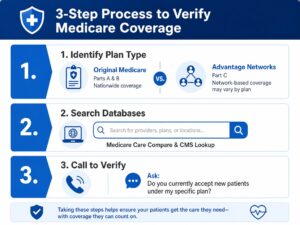
How Do You Confirm a Fremont Doctor Accepts Your Medicare Plan?
This is where good intentions fall apart. People assume “Medicare” is one program with one set of rules. It’s not, and that assumption costs people money and time.
Original Medicare vs Medicare Advantage Networks
Original Medicare, meaning Part A and Part B, lets you see nearly any doctor nationwide who accepts Medicare assignment. Simple in theory. Medicare Advantage flips that. These are private plans, run by insurers like Kaiser or SCAN, that build their own provider networks. Go outside that network and you might pay full price or get denied coverage entirely. If you’re comparing a Medicare Advantage plan against Original Medicare in the Fremont area, check the coordinated care options through Alameda County’s regional Medicare Advantage directory before assuming your preferred doctor is reachable.
Verify Enrollment with Sutter Health, Washington Township, or Kaiser
Fremont’s three biggest players each run their own credentialing and billing systems. Washington Health Medical Group physicians bill through Washington Township Medical Foundation, whose enrollment details are publicly listed for verification. Sutter Health providers operate under the Palo Alto Medical Foundation umbrella. Kaiser is its own closed loop entirely, if you’re not a Kaiser member, Kaiser doctors generally aren’t accessible to you regardless of your Medicare status. The mismatch here trips up more people than you’d think.
Call the Office Before Booking
I know this sounds almost embarrassingly basic, but call the clinic directly and ask three things: do they accept your specific plan, are they accepting new Medicare patients right now, and how far out are appointments booking. Online directories go stale. A front desk person answering the phone today knows more than a database updated eight months ago.
Which Fremont Medical Groups and Hospital Networks Serve Medicare Patients?
| Medical Group | Hospital Affiliation | Medicare Network Type |
|---|---|---|
| Washington Health Medical Group | Washington Hospital | Original Medicare + select Advantage plans |
| Sutter Health / PAMF | Alta Bates Summit Medical Center | Original Medicare + Sutter-affiliated Advantage plans |
| Kaiser Permanente Fremont | Kaiser Fremont Medical Center | Kaiser Medicare Advantage only |
| Independent practices | Varies (often Washington Hospital) | Case-by-case, verify individually |
Washington Health Medical Group
This is the local backbone for a lot of Fremont’s senior care. Washington Health Medical Group physicians work closely with Washington Hospital for inpatient needs, which matters more than people realize, continuity between your primary care doctor and the hospital that treats you during an emergency actually affects outcomes. Their group practice details, including enrollment and service scope, are documented in Medicare’s group practice database for Washington Township Medical Foundation.
Sutter Health / Palo Alto Medical Foundation
Sutter’s Fremont hub runs a genuinely wide net of specialty clinics alongside primary care, which is a real advantage for patients juggling multiple conditions since specialist referrals stay inside one system. The Sutter Health Fremont center’s full department directory shows more than 40 specialties operating out of that single location, and their patient education resource centers offer classes specifically aimed at chronic disease self-management, which I think is underrated as a Medicare-patient resource.
Independent Primary Care Practices
Not everyone wants the big-system experience. Independent practices, often run by a single physician or small partnership, tend to offer longer appointment slots and a more personal rhythm. The tradeoff is usually less integrated specialty access. You’re trading convenience for intimacy, and for a lot of retirees, that trade is worth it.
How Do Patient Reviews Help You Compare Fremont Doctors?
Reviews aren’t gospel, but ignoring them entirely is its own mistake.
What Yelp and Zocdoc Reviews Reveal
Yelp’s Fremont Medicare doctor listings tend to surface the emotional texture of care, how rushed a visit felt, whether staff seemed to actually care. Zocdoc leans more transactional, showing appointment wait times and booking friction. Neither tells the whole story alone, but together they paint something closer to reality than either does solo.
What Healthgrades Ratings Reveal
Healthgrades pulls a different thread entirely, focusing on board certification history and more formal patient satisfaction metrics. Cross-referencing a physician’s Healthgrades profile for Fremont family practice providers against their Yelp reputation often confirms whether the credentials and the bedside manner actually line up.
Red Flags to Watch in Online Feedback
A few patterns worth flagging in your own research:
- Repeated complaints about rushed 10-minute visits with no follow-up questions answered
- Multiple mentions of billing surprises or confusing copays that weren’t explained upfront
- Comments describing difficulty reaching the office by phone for urgent visits
- Patterns of long waits for specialist referrals to actually get processed
One or two negative reviews mean nothing. A pattern across a dozen reviews over two years means something.
What Preventive and Chronic Care Services Should Medicare Cover?
Original Medicare Part B covers annual wellness visits, most routine screenings, and a wide range of chronic care management services, but coverage details shift depending on whether you’re on Original Medicare or an Advantage plan. A genuinely strong Medicare-focused practice proactively schedules these wellness visits rather than waiting for patients to ask. That’s actually a decent litmus test for whether a clinic understands the Medicare population versus one that just happens to accept the insurance.
How Important Is Care Coordination for Senior Patients?
Honestly, this might matter more than the initial doctor pick. A patient managing three chronic conditions across two specialists and a primary care physician needs someone tracking the whole picture, otherwise medications conflict, tests get duplicated, and nobody notices until something breaks. Practices with dedicated care coordinators, common in the Washington Health and Sutter systems, handle care transitions between hospital discharge and follow-up far more smoothly than practices without that infrastructure. If you’re managing multiple conditions, ask upfront whether the practice has this role staffed. It’s not a small detail.
What Questions Should You Ask During Your First Visit?
Come in with a short list, because first appointments move fast and you’ll forget half of what you meant to ask otherwise. Worth covering: how does the practice handle after-hours urgent concerns, who coordinates between your primary care doctor and any specialists, how are medication changes communicated, and what does the process look like if you need to be admitted to the hospital. Also ask plainly whether they’re accepting new Medicare patients long-term, not just for this one visit. Some practices take new patients seasonally, which nobody advertises clearly.
Follow-Up Questions Patients Often Ask
Can You Switch Medicare Doctors Mid-Year?
Yes. Original Medicare lets you switch primary care physicians essentially anytime. Medicare Advantage plans sometimes have narrower windows or require staying within network, so check your specific plan’s rules through Alameda County’s HICAP counseling resources if you’re unsure, since free Medicare counseling through California’s Health Insurance Counseling and Advocacy Program exists specifically to untangle these plan-specific questions.
Does a Doctor’s Language or Cultural Fit Matter?
More than most people admit upfront. Fremont’s population includes large South Asian, Chinese, and Afghan communities, and a doctor who speaks a patient’s first language or understands cultural context around family involvement in care decisions tends to build faster trust. That trust translates into patients actually following through on care plans instead of nodding along and ignoring instructions later.
How Often Should Medicare Patients See Their Primary Doctor?
Annual wellness visits are the floor, not the ceiling. Anyone managing active chronic conditions should expect quarterly check-ins at minimum, sometimes monthly depending on severity. If your current doctor only wants to see you once a year despite ongoing health issues, that’s worth questioning.
Conclusion
There’s no single crown for “best Medicare doctor in Fremont, CA,” and I’d be skeptical of any list claiming otherwise. What actually works is combining Medicare.gov’s official verification data with real patient feedback from Yelp and Healthgrades, then narrowing based on which hospital network and which chronic conditions matter most to your situation. My aunt eventually landed with a Washington Health physician who called her back within a day, every time. That’s not glamorous. It’s just what good Medicare care actually looks like, and it’s worth the legwork to find it for yourself.